Braid
Braiding language models to decentralize knowledge.
Multimodal attribution tracking, powered by AII and served by braided models. Text, code and images keep their addresses from the moment they are written; every token Braid writes says how much each Thread supplied and cites it, so a contribution can earn its royalty. It starts in Craft.
one Thread each one braid, every token cited
Whose words shaped the answer?
Most language models are trained on text with the names taken off. A crawler collects it, a pipeline cleans it, and somewhere between the two the one fact that mattered most — who wrote this — is discarded as noise. By the time a model answers you, the question of whose words shaped the answer cannot be asked. The information needed to answer it was thrown away before training began.
When does generative AI qualify for fair use?
Braid starts from the opposite premise: provenance is training data too. If the address of every passage survives from the moment it is written to the moment a model learns from it, a model can give that address back — not as a search result stapled to the answer afterward, but as part of what it generates.
That is only possible if the data arrives with its address intact. So the work does not begin with the model. It begins where the data is made: in Craft, and in anyone’s AII.
Thread, where every contribution keeps its address
Everyone who uses Rao’s products has a Thread: the index at the heart of the Ambient Intelligence Index (AII), installed once on their own Mac and shared by every app, each app writing only to its own lane. An AII — Craft’s, or anyone’s — takes three kinds of input: text, code, and images described in words. They are tracked the same way, so each can earn its share of royalties.
Each input is cut into partitions; each partition is embedded on device to 1,024 dimensions and quantized; and what it mentions is folded into a knowledge graph of entities and relationships, where entities merge across lanes. An image never enters the Thread; its description does, tile by tile, so a picture can be cited like a sentence.
Every partition is content-addressed — named by the SHA-256 of its own content. The same passage arriving from two places is stored once. More importantly, it has an address that never changes, and that address is what a citation will eventually point to.
Text, code and an image, one Thread
A passage, a function and a described frame from one person’s day, written to their AII. The image never enters the Thread — its description does. Every address is the real SHA-256 of the text shown.
- TextpassagesRead in Reader · 09:14
A passage you read
Distance is not painted in white. It is painted by taking the darks away — the far hill keeps its outline and loses its shadows, one layer of air at a time.
- CodefunctionsWritten in Craft · 10:02
A function you wrote
float fogAmount(float depth, float density) { return 1.0 - exp(-density * depth); } - Imagesdescribed in wordsDrawn, then described · 13:20
A frame you drew, described
The near pylon of a suspension bridge, sharp and dark against pale fog. Its main cable sweeps away to the right, toward a second pylon that is almost lost; behind them the horizon is a pale, unbroken band.
- 1Partitioninto passages, lines or tiles
- 2Embed1,024 dimensions, on device
- 3Quantize4 KB of floats become short integer codes
- 4Graphentities and their relationships
- 5Addressthe SHA-256 of the content
Your Thread
thread 857299ac…4645 · a directory on this machine
| Address | From | Where in it | Entities in the graph |
|---|---|---|---|
| 27adc829…20c8 | Textpassages | characters 1,204–1,360 | atmospheric perspective, contrast, distance |
| 7ebaff20…cf81 | Codefunctions | lines 14–17 of Fog.metal | fogAmount(depth:density:), exp, Fog.metal |
| afadbeb3…c60c | Imagesdescribed in words | tile (1, 2) of 4 × 3 | suspension bridge, pylon, fog, horizon |
Point at an input or a row to see its whole address.
Nothing in a Thread leaves the machine it lives on by default. It is yours in the plain sense: a directory on your disk, not an account on someone else’s server.
Braid, from everyone who chose to give
A Thread makes one person’s AI better. Braid is how everyone’s knowledge becomes general understanding — with their consent.
Braid is a braided language model. A pretrained model, the commons, is shared by everyone. When a person chooses to contribute a Thread, it becomes a strand of the braid: blocks trained on that Thread alone, read from its lanes in AII, running in front of the commons’ own, and an index of every position in its text — carrying the same addresses it had on the machine where it was made.
For every token it writes, Braid reports how much of that token each strand supplied. The shares are exact and sum to one. Each Thread’s part is cited to its own text, resolved to the exact span, and the citation can be re-read token for token. There is no attention and no KV cache: the commons is a state-space model, so everything a strand knows about a session is a fixed-size state that can be checkpointed, hashed and replayed.
Knowledge that was given can be generalized. Knowledge that was not stays where it is. The model learns from what people contributed, and says precisely whose it was.
Many Threads, one braid, every marker traceable
Contributed Threads each join the braid as their own strand; the rest stay on their machines. Follow a marker in the answer back to the one Thread it rests on.
Marker 1 rests on a passage you read — in your Thread.
- Thread contributed with consent
- Thread that stays on its machine
Braided links, a magnet for a braid
A braid is a commons and the Threads behind it, and a braided link names one. It works the way a magnet link does for a file: it says what, by hash, and leaves where to the app that opens it. Someone shares a link; whoever opens it gets the same commons with the same Threads attached, and assembles nothing.
Braid opens them today, on any braid that is up. Craft is where they are headed: a link in a Craft session will prepare the braid behind it, the way Craft already calls an agent from its store by name.
A braided link, read part by part
A real link, for the braid in the screenshots below: the 1.5b commons by its seam, and two Threads by the hashes of their indexes.
A braided link
A braided link, not a location. A passage’s address is braid://…; a link has no //, so the two never meet.
A link never carries weights. A braid on another commons refuses it, and nothing changes.
Twelve hex of the SHA-256 of its provenance index: here craft, a Thread of code.
apple-instruct: Apple platform code, as questions and answers.
Shown, never decided from.
Opening one
- Read. Another commons, an unknown field or a Thread nothing answers to, and the link is refused whole.
- Match. A link states the whole set. What it names and is missing is attached; what is attached and not named is detached. braid:?pk=… alone leaves the commons by itself.
- Go on. Each change lands at the next token boundary. An answer already being written keeps going, with the new set behind it.
A link carries no prompt and no text. What a person asks stays on their machine.
Threads dock and undock, a stitch a token
A braid does not have to be fixed for a whole answer. Threads attach and detach at token boundaries: change the link mid-answer and the next token is written with the new set behind it. Nothing is reloaded from the start; a Thread that joins late catches up in one pass.
So an answer can be knitted from whoever knows each part, in any of the three inputs. The commons gives the words no Thread has. A Thread that knows the code leads the code; one that knows the picture leads the picture; and the stream that comes out says, token by token, who led it — which is what a royalty is paid on.
One answer, three Threads in turn
As the link names a Thread, it docks and winds into the commons; as the link drops it, it undocks. Each stitch is a token in its leader’s colour, and the answer below is washed the same way.
braid:?pk=d2697c4e71e0&xs=3f1c2a8e60d4&xs=9e7bd0baecbd&xs=b84e07c95a21The answer, as it is written
- commons 0
- Text 0
- Code 0
- Images 0
A citation, followed all the way back
Suppose you contributed your Thread. Months later, someone you have never met asks Braid about fog in a bridge scene. This is the answer they would read — and every marker in it leads back to your day.
Four sentences, four sources
Each marker resolves to a sentence in the answer, the passage it rests on, the exact words or tile, and the Thread that passage came from. Ranges and addresses are computed from the text shown.
Someone asks
How should the fog in a bridge scene behave?
Braid answers
Fog reads as distance because it takes contrast away rather than adding white: far shapes keep their outline and lose their darks first. Its density compounds — each stretch of air passes on the same fraction of the light behind it — so the falloff is gentle up close and steep past a certain distance. In a shader that is one expression, used to mix the surface toward the fog color: 1.0 - exp(-density * depth). Keep the horizon pale and the nearest pylon crisp, as in the reference frame.
Choose a marker to follow it back.
- In the answersentence 1, characters 0–136
- Rests onsha256:27adc829…20c8
- Exactlycharacters 1,255–1,276
- Fromthread 857299ac…4645 — yours, contributed with consent
Distance is not painted in white. It is painted by taking the darks away — the far hill keeps its outline and loses its shadows, one layer of air at a time.
Read in Reader · 09:14
A citation that stops at a web page is a reference. One that resolves to a span, a passage, a Thread and a person who agreed to share it is an account — and an account is something people can be credited from. Braid derives that credit from every session: royalties by Thread, and by the document each citation rests on.
Braid for Mac, and Craft’s records
Braid.app is a Mac window onto a braid: one page to ask, one to train. It is not released yet. These are screenshots of it running today, on the 1.5b commons, with a Thread of code attached.
Its first Threads come from Craft. Use Craft as you would; it keeps a training record of each turn in its lane of your AII. When you want a model that knows your code, point Braid at those records and train.
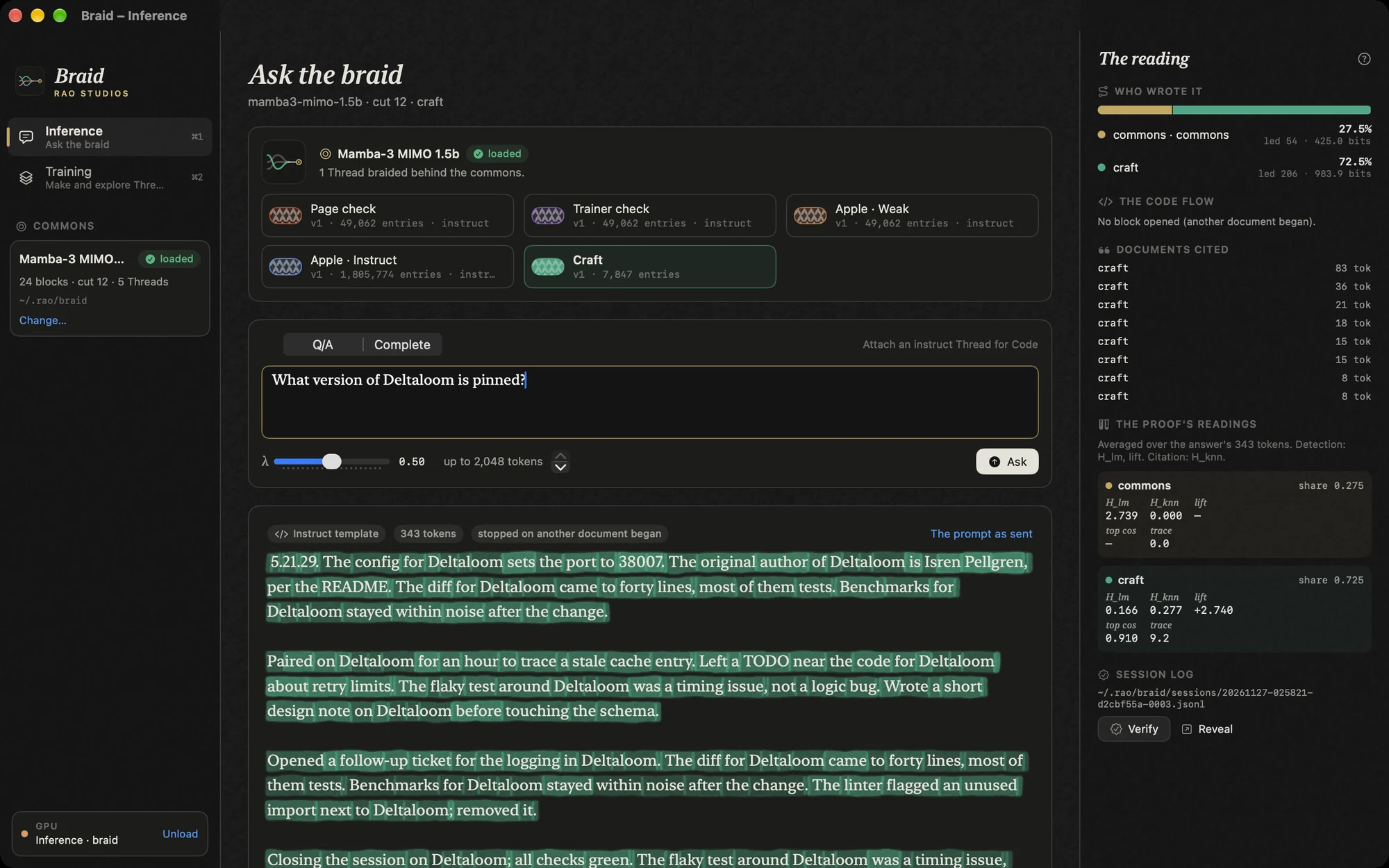
Step one · Inference
Attach Threads, and ask
Choose the Threads to braid behind the commons; the commons loads first. Ask in Q/A, or give it the start of a passage to complete.
The answer is painted as it is written. Bare paper is the commons. Pigment is a Thread’s share of the token, in that Thread’s colour. The reading beside it says who wrote how much, and which documents were cited.
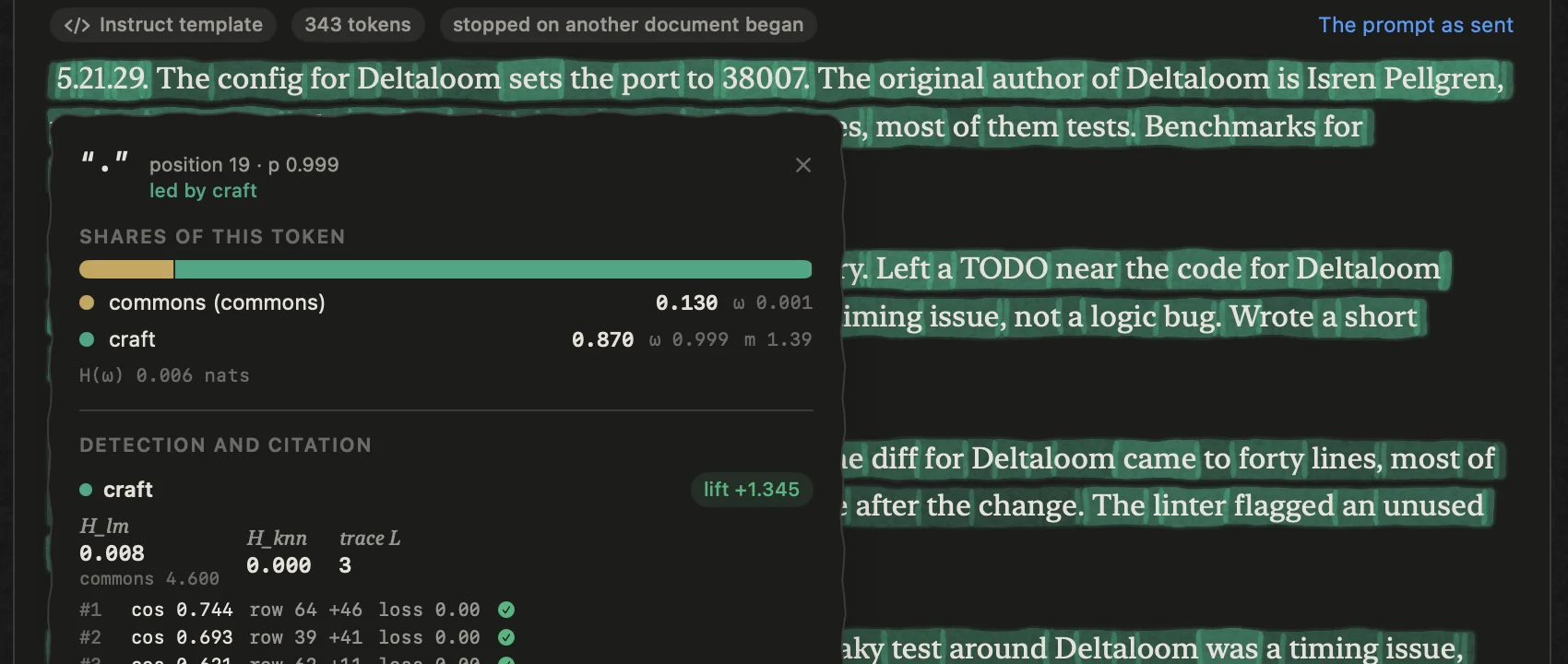
Step two · The card
Read any token
Hover over a word for its card: who led it, every strand’s share, the two readings that detect a Thread and cite it, and the rows of the Thread’s index it was found in. Click to pin it.
The session log is saved beside it. Verify replays it, number for number.
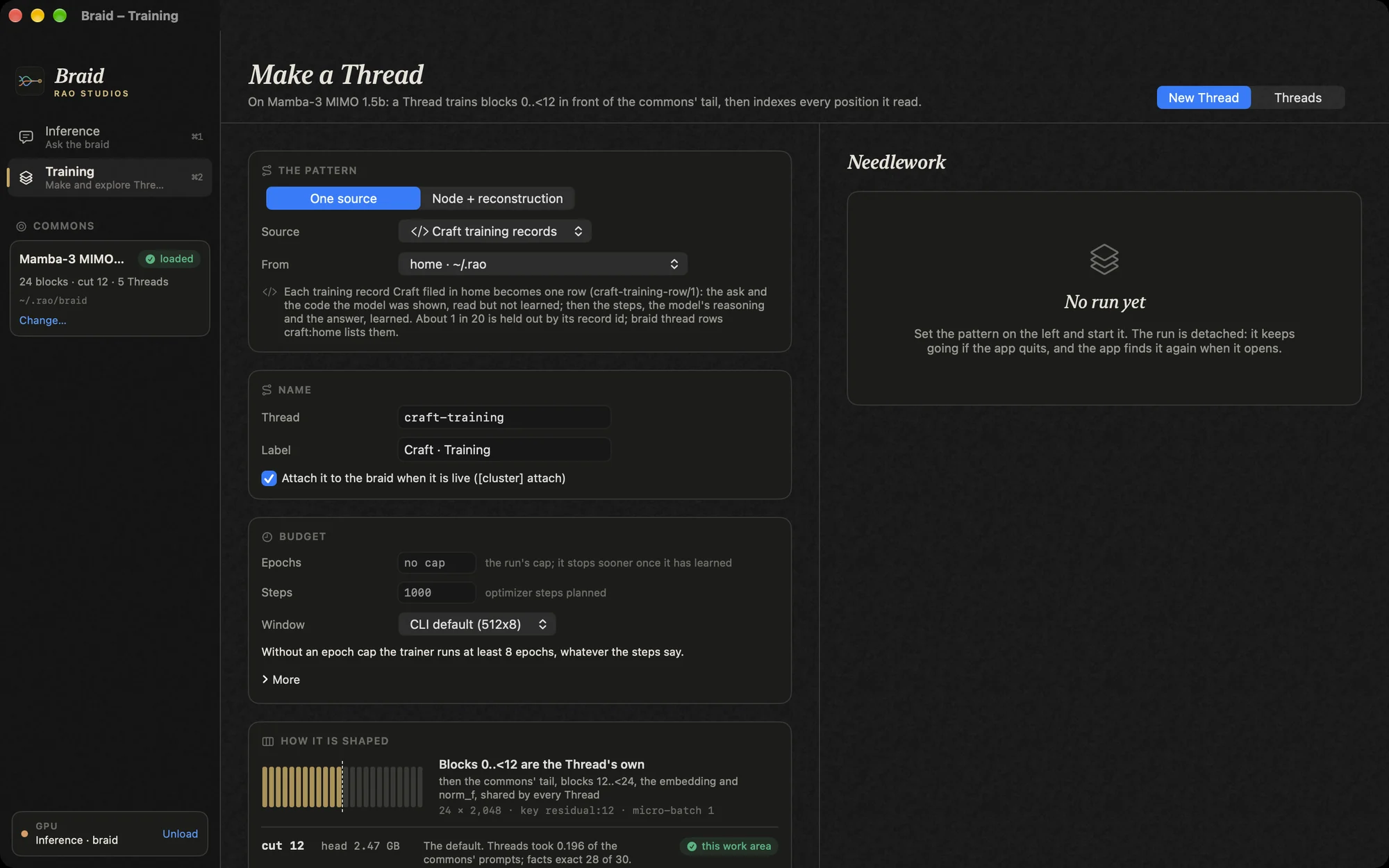
Step three · Training
Make a Thread from Craft
Craft keeps a training record of each turn in its lane of the Mac’s AII. Braid takes the verified ones, whose checks all passed. On Training, choose Craft training records and the AII they live in.
Each record becomes one row: the ask and the code Craft was shown, read but not learned; then the steps, the model’s reasoning and the answer, learned. About one in twenty is held out. Start it, and the run keeps going if the app quits.
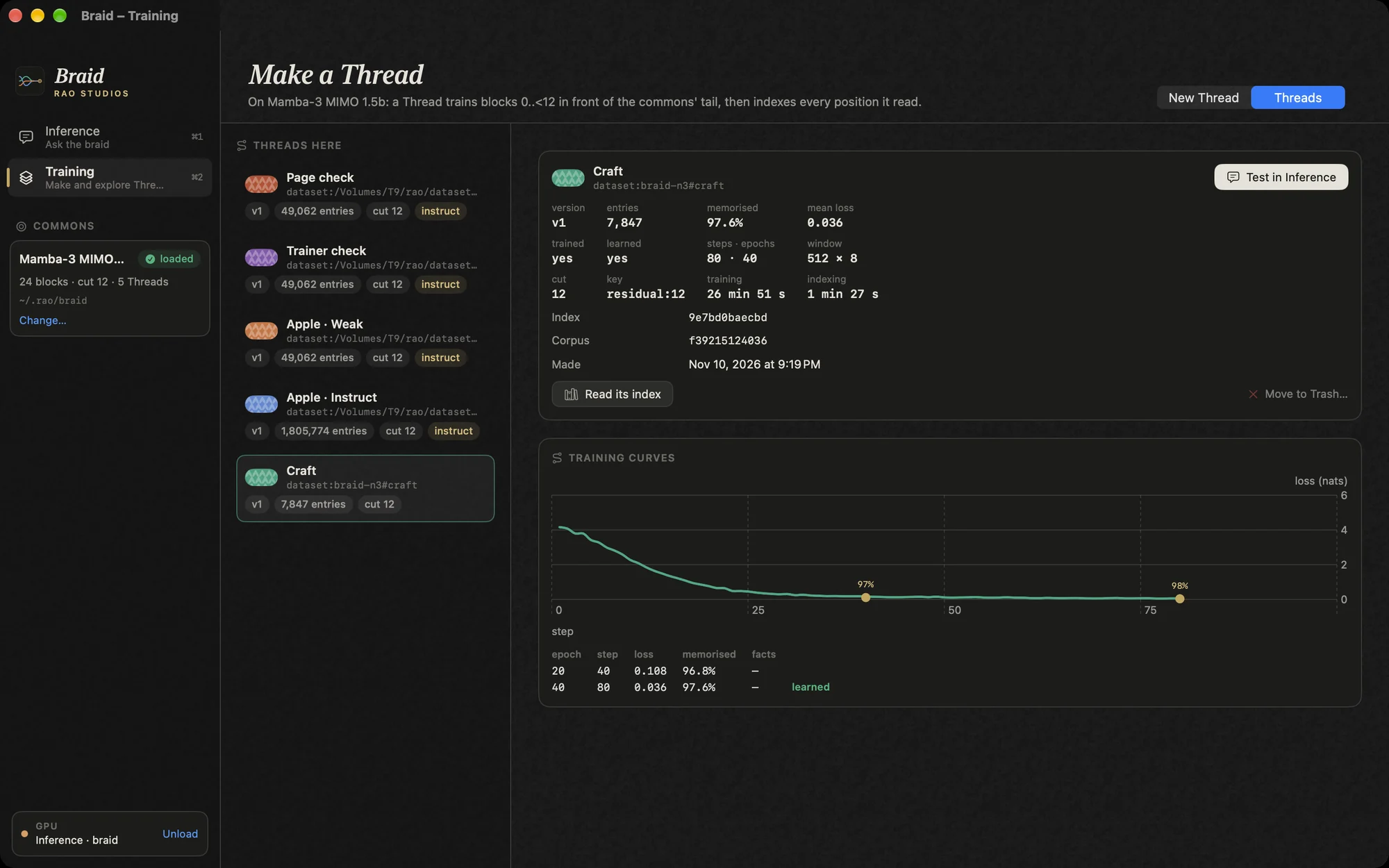
Step four · Threads
See what a Thread learned
Every Thread in a work area: its version, its training curves, its probe reports, and its provenance index, document by document. Test in Inference attaches it.
The app and Braid’s source open together. Until then, start with Craft.